Bridging the Gap in Automotive Supply Chains – Apptronik Apollo’s Deployment at Mercedes-Benz
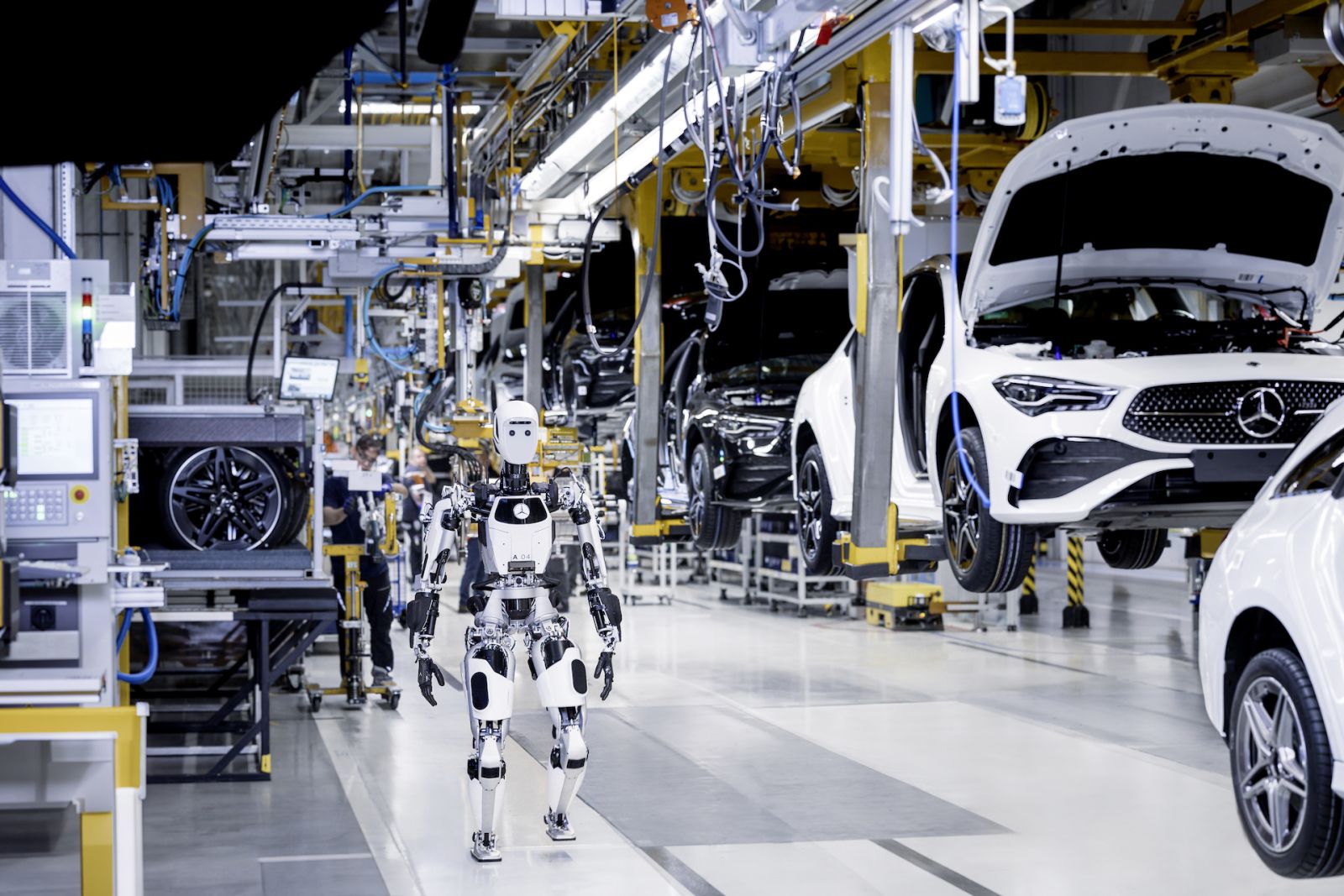
As the automotive industry faces severe labor shortages in physically demanding roles, Apptronik has partnered with Mercedes-Benz to deploy its advanced humanoid robot, Apollo, directly onto the manufacturing floor. Unlike research-focused prototypes, Apollo is engineered from the ground up for commercial supply chain operations, logistics, and heavy manufacturing.
Apollo stands out due to its highly modular design. Its torso can be detached from its bipedal legs and mounted on a wheeled base or a stationary pedestal, offering immense flexibility for different factory roles. Operating with a swappable battery system, Apollo is designed for 22 hours of continuous daily operation. A critical technological achievement of Apollo is its unique force-control architecture, which prioritizes safe, compliant interactions with human workers. Instead of rigid, heavily geared motors, Apollo utilizes custom linear actuators that absorb shock and yield to physical resistance, making it inherently safe to work alongside human line workers without requiring protective safety cages.
The HDT Testing Perspective: Deploying a modular robot in a high-stakes automotive manufacturing environment requires flawless hardware and software integration. Apollo’s modularity means its operating system must seamlessly adapt to different physical configurations on the fly.
HDT excels in this exact domain through comprehensive Hardware-in-the-Loop (HIL) and API Testing. When Apollo switches from a bipedal configuration to a wheeled base, the internal communication protocols must recalibrate instantly. Our team develops automated test suites to validate these internal APIs, ensuring zero data loss or latency during configuration shifts. Additionally, HDT’s Performance & Load Testing is crucial for robots designed for 22-hour operational cycles. We simulate prolonged physical stress and continuous battery hot-swaps to evaluate thermal management systems and ensure the robot's Diagnostic Trouble Code (DTC) reporting functions perfectly, alerting facility managers to maintenance needs long before a critical hardware failure occurs.
(Source: https://spectrum.ieee.org)